
When a laptop leaves your building for the last time, what proof do you still hold that the data on it is no longer a risk?
This is why ADISA Standard 8.0 matters. It is a recognised, independently audited framework that evaluates whether an ITAD provider can manage data securely and prove it through documented controls and traceable outcomes. When disposal is questioned in an audit, when an insurer reviews controls, or when a regulator asks how risk was managed, ADISA Standard 8.0 gives organisations a defensible position based on evidence, not reassurance.
What certification changes in IT asset disposal
Disposal sits within data protection law, information security governance, and third-party risk management. Devices leaving an organisation may still contain personal data, commercially sensitive information, or regulated datasets. Under UK GDPR, responsibility for that data does not transfer automatically to a supplier.
Without certification, organisations rely on supplier assurances, internal policies, or generic certificates. These can describe intent, but they often fail to demonstrate effectiveness. Auditors look for independent assurance and repeatable controls. They also look for evidence that links outcomes to individual assets.
Certification provides a shared benchmark and a clearer due diligence route. It allows organisations to reference an externally defined standard rather than relying on internal interpretations of what secure disposal should mean.
What is ADISA Standard 8.0?
ADISA Standard 8.0 is an ICT Asset Recovery Standard designed specifically to assess how IT asset disposal providers manage data risk. The standard is recognised by the UK Information Commissioner’s Office as part of the GDPR Certification Scheme and is audited by UKAS-accredited certification bodies.
Its scope maps to real ITAD workflows. It examines how assets are received, identified, tracked, sanitised, stored, reused, and destroyed. Controls are assessed across:
- physical and logical security
- personnel access and segregation of duties
- process integrity and exception handling
- data sanitisation methods and verification
- reporting, traceability, and record retention
The result is a verified assessment of whether a supplier can manage data securely throughout the disposal lifecycle and provide evidence of that management.
ADISA Standard 8.0 vs ADISA Essentials
ADISA operates more than one certification route, each aligned to different risk profiles.
ADISA Essentials focuses on baseline governance and procedural controls. It confirms that a provider has defined processes, understands data protection responsibilities, and applies consistent handling methods. For some low-risk use cases, this may provide sufficient assurance when supported by strong internal controls and clear contractual requirements.
ADISA Standard 8.0 goes further. It tests whether controls are appropriate for the level of data risk involved and whether outcomes are evidenced reliably. The standard is designed for environments where data exposure would carry regulatory, financial, or reputational consequences.
The decision between these certifications should be driven by data impact, not by whether a supplier can collect at no charge.
Understanding DIAL within ADISA Standard 8.0
A core element of ADISA Standard 8.0 is the Data Impact Assurance Level, known as DIAL.
DIAL enables the data controller to assess the potential impact if data were compromised during disposal. It considers factors such as data type, sensitivity, volume, and likely consequences. Assets are then assigned a DIAL rating, typically from 1 to 3.
Higher DIAL ratings indicate greater potential harm and require stronger controls. A supplier certified to handle DIAL 3 assets has demonstrated the ability to process the highest risk data sets under ADISA Standard 8.0 requirements.
This framework helps organisations avoid a common mistake: applying a one-size approach to disposal. Instead, controls are aligned with impact, and supplier capability is matched to client risk.
Why DIAL matters in audits and regulatory reviews
From an audit perspective, DIAL provides structure. It shows how risk was assessed, why specific controls were selected, and whether the supplier was certified to meet those requirements. This reduces reliance on subjective explanations when a review is conducted months later.
Regulators assess whether appropriate measures were applied based on risk. DIAL demonstrates that disposal controls were chosen deliberately and proportionately to the potential impact of data exposure.
Protections delivered by ADISA Standard 8.0
Audit-ready evidence: ADISA Standard 8.0 supports documented evidence that remains available after disposal is complete. Certification reports, chain of custody records, and asset-level data destruction certificates support internal and external audits without retrospective reconstruction.
Reduced exposure to data incidents: The standard requires validated data sanitisation processes and defined handling of failed erasures. Assets should not be released for reuse or recycling without verified outcomes. This materially reduces the likelihood of residual data exposure.
Support for insurance and third-party risk assessment: Insurers increasingly evaluate lifecycle data controls. Working with an ADISA Standard 8.0 certified provider demonstrates active management of disposal risk, supporting underwriting discussions and strengthening third-party risk registers.
ADISA Standard 8.0 at CiLifecycle
 CiLifecycle operates in alignment with ADISA Standard 8.0 as a delivery framework. Asset tracking, data sanitisation, and reporting are structured to produce defensible evidence rather than broad statements.
Each data-bearing asset is individually tracked. Erasure or destruction outcomes are recorded against serial numbers. Chain of custody documentation records movement from collection through final processing. Where reuse or remarketing is appropriate, data security controls are applied before assets exit controlled environments.
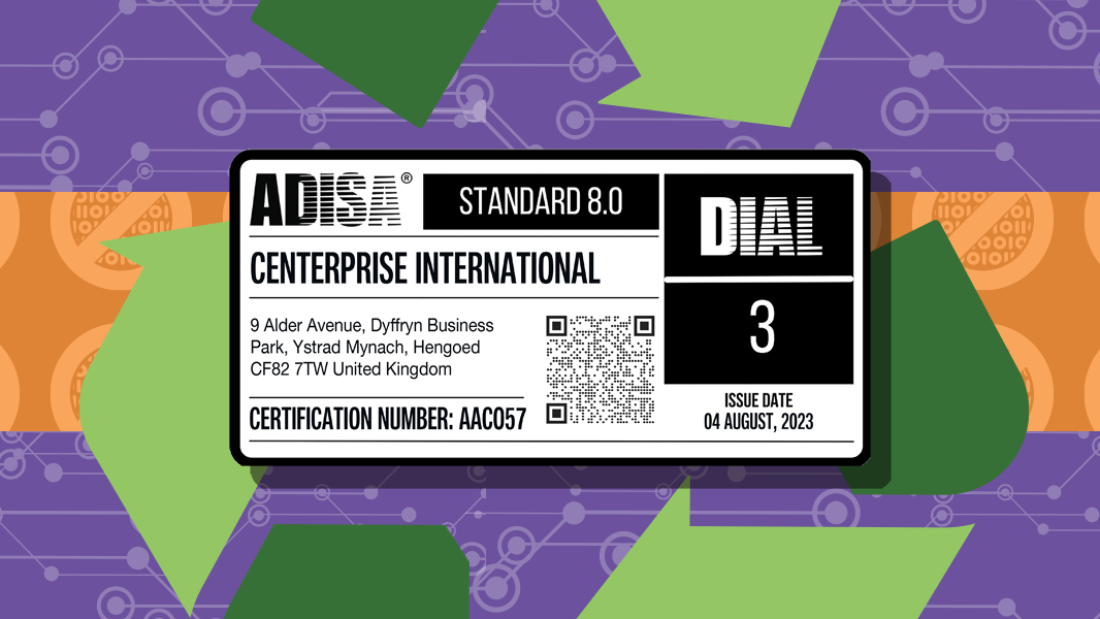
ADISA recently confirmed that Centerprise International has passed its Data Capability Audit against the ICO-approved ADISA Standard 8.0, maintaining certification at Distinction and demonstrating capability to deliver ITAD services at DIAL 3. This confirms the ability to manage the highest data risk levels under the standard.
For clients, this supports disposal activity that aligns with regulatory expectations and is backed by auditable records.
Certification protects the organisation
ITAD is one of the few areas where an organisation can do the “right” operational thing and still be exposed if the evidence is weak. Devices can leave the site quickly, and the business may believe the risk is closed. Audit and incident reality are different. What matters is whether data risk was controlled and whether outcomes can be proven.
ADISA Standard 8.0 provides a recognised benchmark for that proof. It supports better due diligence, clearer supplier selection, and stronger defensibility when disposal is reviewed.
Want to understand how CiLifecycle can support your organisation?
If you would like to discuss how ADISA Standard 8.0 certified IT asset disposal can support your security, compliance, and ESG objectives, contact CiLifecycle to learn how we can help your organisation manage data risk with confidence.
